
Insights

AI Bias in Education: District Audit Guide

Audit AI bias in education with a district framework for testing access, outputs, human decisions, disparities, appeals, and ongoing monitoring.

Published By SchoolAmplified Editorial Team 16 min read
  • Superintendents
  • Civil rights and student services leaders
  • Technology and data leaders
  • Human resources leaders
  • School board members
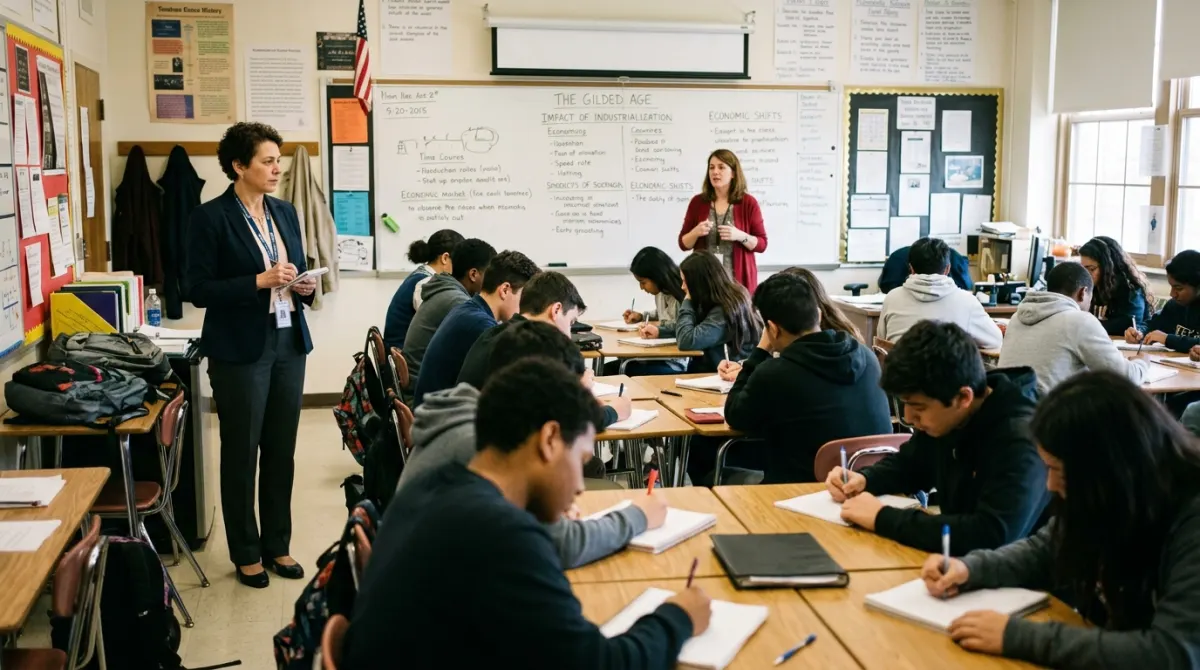
Educators observing students working in a diverse secondary classroom

16 min read

Test the whole decision, not just the AI output

Bound the use, include affected people, compare results, protect human authority, and create a real path to correction.

AI bias in education is not only a problem inside an algorithm. It can enter through the data a tool learned from, the students or staff who can access it, the task a district assigns it, the way people interpret its output, and the action that follows.

That is why a vendor statement that a model was “tested for bias” is not enough. A district needs to know whether this version of the tool, used for this task, with these people and conditions, produces a supportable and correctable result.

In brief: name the decision before testing the technology. Include the people most likely to experience different performance or access. Compare both errors and consequences, not just average accuracy. Keep a trained person in control of consequential decisions. Give students, families, applicants, and staff a clear way to question and correct the result. Then monitor the live workflow for changes that a one-time review could miss.

This guide offers an operational audit framework. It is not legal advice, a statistical validation protocol, or a substitute for federal and state law, district counsel, civil rights review, collective bargaining obligations, or qualified research support.

Why AI bias is a district operating issue

AI can make an existing process faster without making it fairer. It can also repeat a weak assumption at a scale that manual work never reached.

The U.S. Department of Education's Office for Civil Rights explains in its resource on avoiding the discriminatory use of artificial intelligence that AI used in schools can create or contribute to discrimination. The resource illustrates risks involving AI detection, translation, discipline, school safety, disability, and individualized education programs. It also makes an important operational point: existing federal civil rights requirements still apply when AI influences the process.

NIST's Special Publication 1270 on identifying and managing bias in AI separates harmful bias into systemic, computational and statistical, and human categories. That is a useful correction to a common district mistake. Testing the model output alone can miss the policy, access, training, staffing, and decision habits that shape the result.

Recent research shows why local testing matters. A peer-reviewed audit of language models used to rate applicants used application materials for K-12 teaching positions in a large U.S. public school district. The researchers found moderate race and gender disparities across the models they tested, while also warning that the audit method and findings had limitations. The lesson for districts is not that every model will behave in the same direction. It is that plausible-looking ratings can vary with demographic signals even when qualifications are held constant.

The timing is practical, not theoretical. As districts prepare for the 2026–27 school year, state guidance is increasingly asking them to make informed local decisions. Illinois' July 2026 statewide AI guidance, for example, centers context-sensitive purpose, human relationships, and the experiences of educators, students, parents, and caregivers. A district bias audit turns those principles into a repeatable operating process.

Where bias enters a school AI workflow

“Is the AI biased?” is too broad to guide a decision. Ask where a harmful disparity could enter and what would happen next.

1. The purpose and historical process

An AI system can inherit the assumptions of the process it is meant to automate. A prediction built from past referrals, placements, disciplinary actions, hiring decisions, or program participation may reproduce patterns that reflect unequal access or treatment.

Before examining a model, ask whether the target itself is appropriate. A precise prediction of a weak or unjust proxy is still a weak decision tool.

2. The data and model

Training, evaluation, and local operating data may underrepresent important languages, disabilities, grade levels, communication styles, devices, schools, or community conditions. The model may perform well on average while failing more often for a smaller group.

Districts rarely receive enough access to independently inspect a commercial model's training data. That limitation should increase the need for product-version evidence and local outcome testing, not produce blind confidence.

3. Access and interaction

People do not experience a tool under identical conditions. Device access, broadband, assistive technology, reading level, language, speech pattern, motor input, account setup, and staff support can change who successfully completes a task and whose information the system interprets correctly.

This is where bias review and an AI accessibility review need to work together. A tool that produces comparable outputs only for people who can use its interface is not delivering comparable access.

4. The human workflow

Human review does not automatically remove bias. Reviewers may defer to a score because it looks objective, scrutinize some flags more than others, lack the time or information to correct an error, or never see the cases that the system filtered out.

The workflow must make disagreement possible. A reviewer needs source evidence, authority to override, sufficient time, a documented standard, and an alternative path when the AI output is unreliable.

5. The consequence and remedy

The same error has different significance in different settings. An awkward first draft of an internal agenda can be corrected before it matters. An incorrect flag that contributes to discipline, a denied service, a lower grade, a lost job interview, or a safety response can materially affect a person.

Audit depth should follow consequence. High-consequence uses require stronger evidence, smaller deployment boundaries, independent review, visible recourse, and a lower tolerance for unresolved uncertainty.

Use the BIAS district audit

The BIAS audit has four parts: Bound the use, Include affected conditions, Audit the workflow, and Set safeguards. It can be used before purchase, during a pilot, after a material product change, and at renewal.

B — Bound the use and consequence

Write one sentence that defines the workflow:

For these users, the system uses these inputs to produce this output for this task. This person reviews it before this action may occur, and this alternative process remains available.


District Perspective

The work gets easier when teams operate from shared information

Communication, continuity, and implementation improve when the model is more coordinated.

  • Bias can enter through data, access, model outputs, and the human workflow around them
  • District tests must match the exact local use and consequence
SuperintendentsCivil rights and student services leadersTechnology and data leaders
The work gets easier when teams operate from shared information

District context

The work gets easier when teams operate from shared information

Communication, continuity, and implementation improve when the model is more coordinated.

Do not audit a product category such as “AI analytics.” Audit a particular use, such as identifying students for an optional tutoring invitation or summarizing public comments for staff review.

Document:

  • the educational or operational problem and non-AI alternative
  • who is affected directly and indirectly
  • the inputs, output, reviewer, and downstream action
  • whether the output informs access, grading, discipline, safety, special education, employment, or another material opportunity
  • the current process and its known limitations
  • the product and model version, enabled features, integrations, and update behavior
  • the owner who can approve, restrict, pause, or stop the use

If the team cannot explain what action follows the output, it cannot evaluate the consequence of an error.

I — Include affected people and real conditions

Build a test matrix around the people and conditions relevant to the approved use. That may include grades, schools, languages, disability access needs, devices, subject areas, role types, communication formats, and realistic variations in source material.

Protected-characteristic data requires careful handling. District counsel, privacy leaders, civil rights staff, and a qualified methodologist should determine what information may be collected or used, at what level, for what purpose, and with what safeguards. Do not expose a student's identity or infer a sensitive characteristic merely to make a test convenient.

Inclusion is more than a dataset. Ask affected people to help identify failure modes:

  • Can a student understand that AI is involved?
  • Can a parent access the explanation in a language and format they can use?
  • Can a person complete the workflow without a particular device or interaction method?
  • What context would a counselor, teacher, case manager, or hiring manager need before acting?
  • How would someone recognize an error and whom would they contact?

Use synthetic or de-identified cases for early testing where appropriate. Before a consequential live use, confirm that the evaluation conditions reasonably resemble the district's actual setting.

A — Audit outputs and the complete workflow

Run the same defined cases through the same product version and workflow. Keep source material, prompts, settings, rubric, reviewer instructions, and decision thresholds consistent enough to support a comparison.

Measure what matters for the use:

  • completion, failure, and abandonment rates
  • false positives and false negatives where a valid reference answer exists
  • output quality against a task-specific rubric
  • selection, recommendation, flag, or escalation rates
  • review time, correction time, and override rates
  • differences by relevant user condition or group when lawful and methodologically supportable
  • complaints, appeals, reversals, and unresolved errors
  • whether the non-AI path produces a materially different result

Do not let one overall accuracy number hide the pattern. Results should be examined at the level where the district will act, while protecting privacy and avoiding conclusions from samples too small to support them.

Also test the people around the model. Give reviewers incorrect, incomplete, ambiguous, and conflicting outputs. Observe whether they find the problem, consult the original evidence, follow the standard, document the decision, and use their authority to override.

The NIST AI Risk Management Framework Core calls for fairness and bias identified during mapping to be evaluated and documented, with risks tracked over time. For a district, that means preserving the test design, results, limitations, decision, and owner—not simply recording that a vendor questionnaire was completed.

S — Set safeguards, recourse, and monitoring

An audit is useful only if the district can act on what it finds.

Before deployment, define:

  • permitted and prohibited uses
  • the evidence a reviewer must consult
  • who has final authority and who may override
  • when a second review is required
  • how students, families, applicants, or staff are told that AI informs the workflow
  • a plain-language way to request an explanation, correction, accommodation, or non-AI process
  • what records support an appeal without exposing unnecessary personal data or vendor secrets
  • monitoring frequency, accountable owner, and reporting audience
  • triggers for retesting after a model, feature, prompt, threshold, data source, or workflow change
  • stop conditions and a service-continuity plan

Recourse must be usable before the harm becomes difficult to reverse. A general help-desk address is not meaningful recourse if no one can change the grade, discipline record, service decision, screening result, or underlying data.

A district bias test matrix

Use a concise test matrix rather than an open-ended demonstration.

| Test area | District question | Evidence to retain |
| --- | --- | --- |
| Purpose | Is the output necessary and appropriate for this action? | Use statement, alternative considered, decision owner |
| Access | Who cannot use or complete the workflow reliably? | Device, language, accessibility, and completion results |
| Output | Does quality or error vary in relevant conditions? | Cases, reference answers, rubric, version, results |
| Human review | Can reviewers detect, challenge, and correct errors? | Instructions, review time, overrides, unresolved cases |
| Consequence | Do flags or recommendations create different downstream results? | Decision rates, escalations, reversals, service effects |
| Recourse | Can an affected person understand and correct the result? | Notice, contact path, response time, resolution record |
| Change | Does an update alter performance or risk? | Change notice, regression test, approval or pause decision |

The matrix should be proportionate. A low-risk drafting assistant may need a focused quality and access test. A tool that influences a student's placement, an employee's opportunity, or a safety response requires a much stronger design and may be inappropriate if the district cannot obtain the evidence needed to evaluate it.

What not to accept as proof of fairness

District teams should challenge several common shortcuts.

“The model does not use protected characteristics”

Other inputs can correlate with a protected characteristic, and the surrounding process can still produce unequal access or effects. Removing a field does not establish a fair result.

“A human makes the final decision”

Ask whether the person sees the source evidence, understands the tool's limits, has time and authority to disagree, documents the reason, and faces no penalty for overriding. Human presence without meaningful control is a weak safeguard.

“The vendor tested the model globally”

Request the task, population, product version, conditions, metrics, subgroup results, limitations, and date. A global benchmark does not establish local performance for a district workflow.

District Perspective

District leadership needs clearer signals and stronger communication rhythm

Systems feel more credible when guidance and public experience stay connected.

  • District tests must match the exact local use and consequence
  • Human review needs authority, evidence, recourse, monitoring, and stop conditions
District leadership needs clearer signals and stronger communication rhythm

Visible alignment

District leadership needs clearer signals and stronger communication rhythm

Systems feel more credible when guidance and public experience stay connected.

The Southern Regional Education Board's AI procurement questions explicitly ask whether tools have scheduled bias audits. Districts should go one step further and put the audit scope, evidence access, change notice, and corrective duties into the agreement. The companion SchoolAmplified AI procurement guide shows how to connect those requirements to purchasing and renewal.

“The average result is accurate”

An average can hide a concentrated failure. Examine relevant slices, error types, and downstream decisions. At the same time, do not label every observed difference as unlawful discrimination or model bias without a sound design and contextual review. The audit should reveal uncertainty as well as risk.

“No one has complained”

People may not know AI was involved, understand the result, trust the complaint process, or have the time and language access to challenge it. Complaint counts are one monitoring signal, not proof that the workflow is fair.

Set stop conditions before the pilot

Pause or prohibit the use when the district cannot resolve a material problem such as:

  • the output influences a consequential action but cannot be meaningfully explained or reviewed
  • local testing reveals an unexplained, consequential disparity or recurring failure
  • the vendor will not provide enough evidence to evaluate a material claim
  • affected people cannot obtain notice, accommodation, correction, appeal, or a safe alternative
  • reviewers routinely accept outputs without checking the source evidence
  • the tool conflicts with an IEP, Section 504 plan, language-access duty, board policy, or approved workflow
  • a product update changes the model, data flow, threshold, feature, or terms without review
  • the district cannot preserve service when the AI feature is unavailable or stopped

A stop condition is not an admission that every AI use is unsafe. It is evidence that the district has preserved decision authority.

For grading and academic-integrity uses, apply the more specific safeguards in the district guides to human review in AI grading and AI plagiarism checker policy. For IEP-related workflows, use the AI in special education district safeguards and involve the student's team rather than treating a model recommendation as a placement decision.

Run a 30-day bias audit sprint

Days 1–7: define the decision

Complete the one-sentence use statement, consequence assessment, current-process baseline, product version, data map, legal and policy review, audit owner, and non-AI alternative. Decide what evidence would support approval, restriction, further testing, or rejection.

Days 8–15: build and run the test

Create representative normal, edge, access, ambiguity, and failure cases. Define the rubric and comparison measures before reviewing results. Use trained reviewers who understand both the domain and the purpose of the audit.

Days 16–23: test the human system

Observe review, override, escalation, notice, accommodation, correction, and appeal. Ask affected users to assess whether the explanation and recourse path make sense. Investigate differences rather than averaging them away.

Days 24–30: decide and document

Record the results, limitations, unresolved questions, approved boundary, safeguards, owner, monitoring schedule, retest triggers, and stop conditions. Approve, narrow, redesign, defer, or reject the use. Do not convert a time-limited audit into informal permanent deployment.

Where SchoolAmplified fits

A bias audit creates operating knowledge that must remain usable after the committee meeting: the approved purpose, prohibited uses, review steps, known limitations, escalation path, family explanation, appeal route, monitoring owner, and current product version.

District Assist can help authorized staff work from a district-controlled knowledge layer for approved guidance and recurring questions. SchoolAmplified does not certify that an AI product is unbiased, make student or employment decisions, or replace legal, civil rights, statistical, or accessibility review. Its role is to help districts keep trusted knowledge current, communicate rules clearly, preserve human oversight, and carry governed implementation across schools and departments.

That operational layer matters when a principal asks whether an AI flag can support discipline, a teacher needs the approved academic-integrity process, an applicant requests an explanation, or a family reports that a tool does not work in their language or access mode. The answer should come from an owned district process, not a vendor slogan or a forgotten pilot deck.

SchoolAmplified's trust approach and implementation model support the same outcome: AI should work within visible district authority, with clearer communication and a human path to correction.

AI bias audit checklist for school districts

Before approving or renewing a use, confirm that the district has:

  • defined the exact task, users, inputs, output, reviewer, action, and alternative
  • examined whether the existing process or target embeds a weak assumption
  • classified the consequence of an error or unequal result
  • identified relevant access conditions and affected people
  • protected sensitive information used for lawful, necessary evaluation
  • tested the current product version under realistic local conditions
  • measured errors, quality, access, review, and downstream decisions—not only average accuracy
  • examined relevant differences with adequate privacy and methodological support
  • tested whether reviewers can find, challenge, correct, and document errors
  • provided understandable notice and a usable correction, accommodation, appeal, or non-AI path
  • established permitted uses, prohibited uses, owners, escalation, and stop conditions
  • required evidence, audit support, change notice, and corrective action from the vendor
  • scheduled monitoring and retesting after material changes
  • preserved the records needed to explain the district's decision

The goal is not to prove that a tool has no bias. No credible audit can make that universal claim. The goal is to determine whether a specific use is supportable under real district conditions, make uncertainty visible, prevent an AI output from becoming unreviewable authority, and stop the workflow when the evidence no longer justifies it.